Running a Food Business in 2026? Here’s Why You Need the Right Software to Scale Smarter
As we approach 2026, the food service industry is entering one of its most transformative years yet. Customer expectations are accelerating rapidly - faster delivery, more meal customization, transparent nutritional data, seamless digital ordering, and real-time communication are now the norm.

For food entrepreneurs, this means one thing: manual processes and disconnected tools simply won’t keep up. Businesses relying on spreadsheets, phone-based ordering, or outdated software are experiencing slower growth, higher waste, and thinner margins.
This is why meal prep business software and catering business software are becoming essential heading into 2026. These systems now serve as the twin engines powering automation, forecasting, kitchen coordination, delivery efficiency, and customer retention - all from one centralized platform.
In this blog, we’ll explore why 2026 will favor food businesses using smart automation, how AI-driven systems empower growth, and what software features you need to stay competitive in this upcoming year.
The Growing Need for Automation in Food Operations
By the time 2026 arrives, the operational landscape will look very different from just a few years ago. Consumer expectations and kitchen workflows have evolved dramatically since 2020 - and will continue intensifying.
1. Subscription Meal Services + Event Catering Are Converging
Many kitchens are shifting into hybrid models offering:
Weekly meal prep plans
Corporate catering
Event services
Delivery-first menus
Health-focused meal plans
Only integrated software can support such diverse workflows.
2. Ingredient Costs Continue to Rise
As we enter 2026, food businesses will depend heavily on:
Data-backed purchasing
Waste reduction tools
Forecasting models
This level of precision is impossible without automation.
3. Labor Shortages Are Still a Reality
Going into 2026, efficient scheduling and automated workflows will be critical as staff shortages continue across hospitality.
4. Customers Expect Faster Digital Interaction
Heading into the new year, customers want:
Real-time delivery tracking
Online portals
Transparent pricing
Subscription flexibility
Instant communication
Businesses that can’t offer this will fall behind quickly.
2026 will reward food businesses that embrace automation and punish those that rely on manual methods.
What Is Meal Prep Business Software (And Why It Matters for 2026)?
Meal prep business software is becoming a necessity as demand for personalized meals and subscription-based services grows heading into 2026.

What This Software Helps You Do (Going Into 2026):
1. Automate Order & Subscription Cycles
Weekly menus, customer preferences, and billing happen automatically.
2. Generate Accurate Batch & Cooking Reports
Orders convert into ingredient quantities, scaled recipes, and prep tasks.
3. Predict Inventory Needs
As we approach 2026, forecasting becomes mission-critical for controlling food costs.
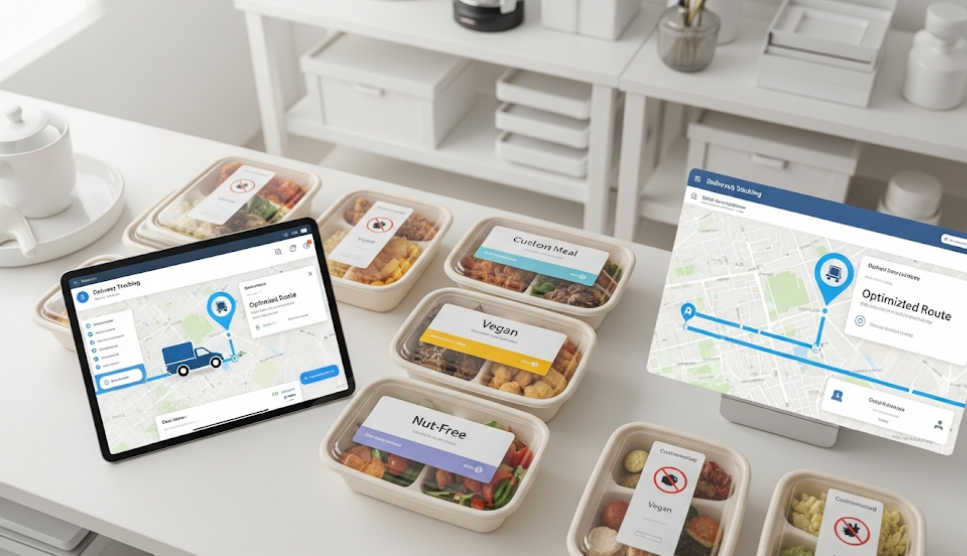
4. Connect Kitchen → Delivery in Real Time
Software manages route optimization, driver assignment, customer notifications, and proof of delivery.
5. Automate Nutrition & Allergen Labeling
Compliance and consumer trust are heavily tied to accuracy in 2026.
6. Deliver Data-Driven Insights
Businesses can track:
Profit margins
Waste levels
Sales patterns
Customer retention
This allows for smarter planning going into the new year.
What Catering Business Software Will Do for You in 2026
Catering is also entering a highly automated era. With event expectations rising in 2026, catering business software will become the centerpiece of event operations.
What Catering Software Handles (Going Into 2026):
Event Scheduling
Manage dozens of events, calendars, and booking conflicts effortlessly.
Menu Customization & Dynamic Pricing
Build menus for specific events with ingredient-based cost calculations.
Staff Coordination
Assign servers, chefs, and drivers based on availability and workload.
Billing, Quotes & Contracts
Fast invoicing, e-signatures, and secure online payments.
Multi-Stop Delivery Logistics
Live route tracking for event drop-offs and equipment delivery.
CRM & Client History
Track preferences, order history, notes, and repeat customers.
Event Profitability Reporting
See which events generate the highest margin and which drive waste.
Heading into 2026, catering businesses need more than planning tools - they need predictive, automated systems that remove chaos.
The Power of Integrated Kitchen Ecosystems for 2026
2026 will favor businesses combining meal prep and catering under unified, efficient systems.
Benefits of an Integrated Workflow Going Into 2026:
Shared inventory insights
No more double-ordering or ingredient shortages.Unified staff scheduling
Staff can be assigned across meal prep and catering seamlessly.Shared CRM system
All clients - whether meal prep or event - live under one system.Consolidated delivery routes
Reduce fuel costs and improve delivery timing.Consistent brand identity
One portal for all customer interactions.Consolidated reporting
One dashboard for all sales, waste, and performance metrics.
As 2026 arrives, integrated software will be the difference between streamlined growth and operational bottlenecks.
Key Features Every Modern Food Business Needs Before 2026
Below is a dual breakdown designed for SEO and clarity.
Meal Prep Business Software Features
✓ Automated order & subscription cycles
✓ Recipe-to-inventory syncing
✓ Nutrition labeling & allergen tracking
✓ Batch cooking automation
✓ Delivery routing & optimization
✓ Loyalty points, referrals & CRM tools
Catering Business Software Features
✓ Event management & client scheduling
✓ Menu builder with smart pricing
✓ Staff scheduling & shift tracking
✓ Contract templates & online payments
✓ Venue logistics & route planning
✓ Client feedback and event reporting
Together, these create a fully connected ecosystem that reduces complexity and maximizes revenue.
Data, AI & The 2026 Technology Shift
As we enter 2026, AI and automation will transition from “nice-to-have” features into industry standards.
The 2026 Tech Trends Food Businesses Must Prepare For:
1. AI Demand Forecasting
Predict ingredients, labor, and order volume.
2. Sustainability Metrics
Track waste, carbon output, and sustainable sourcing.
3. Fully Automated Production Workflows
Inventory → recipes → batch reports → delivery.
4. Cloud Collaboration
Teams can access up-to-the-second data from any device.
5. Predictive Analytics
Software identifies:
Best-selling meals
Low-margin items
Delivery bottlenecks
Customer churn
2026 will be the year businesses shift from reactive operations to predictive ones.
Common Mistakes to Avoid When Choosing Software for 2026
1. Choosing based on price instead of scalability.
You will outgrow cheap software within months.
2. Ignoring integration needs.
Your software must connect with POS, delivery apps, accounting, etc.
3. Not involving the kitchen team.
The people using it daily must understand and support it.
4. Underestimating onboarding.
Good onboarding prevents future headaches.
5. Forgetting brand control.
White-label portals are essential for a modern customer experience.
Avoid these mistakes now, before 2026 arrives.
FAQs
1. What is meal prep business software used for?
To automate ordering, meal planning, batch cooking, inventory management, delivery routing, and customer communication.
2. How does catering business software improve events?
It organizes scheduling, event logistics, menu planning, delivery routes, contracts, and client communication.
3. Can one system manage both meal prep and catering?
Yes - modern platforms unify both under shared inventory, delivery logistics, CRM, and analytics.
4. What features should businesses prioritize in 2026?
AI forecasting, batch cooking automation, subscription tools, event scheduling, analytics dashboards, and route optimization.
5. How much does food business software cost?
Typically $150–$1,000/month depending on business size, users, and workflow complexity.
6. Is AI standard in food business software now?
As we enter 2026, AI is becoming standard for forecasting, optimization, and customer behavior insights.
Final Words
As 2026 approaches, food businesses must prepare for a year driven by automation, digital workflows, and intelligent decision-making. Whether you handle weekly meal prep, event catering, or both, success in the upcoming year will depend on choosing software that unifies your workflow, reduces waste, improves production accuracy, and helps you scale sustainably.
Platforms like Sprwt show what next-generation meal prep and catering business software can achieve - automation, analytics, forecasting, and scalability designed for the food entrepreneurs of 2026.


Comments
Post a Comment