Meal Prep Software and Catering Software: The Smart Backbone of Modern Food Businesses
The food industry has changed dramatically over the last few years. Meal prep companies, catering businesses, cloud kitchens, and delivery-focused food brands are no longer operating with simple menus and manual processes. Today, success depends on speed, accuracy, personalization, and data-driven decision-making. This is where meal prep software and catering software play a critical role.

In 2025 and moving into 2026, food businesses that rely on spreadsheets, disconnected tools, or manual coordination struggle to scale. On the other hand, businesses that adopt modern software systems gain efficiency, consistency, and a competitive edge. This blog explores how meal prep software and catering software work, why they matter, and how they help food businesses operate smarter every single day.
Why Food Businesses Are Adopting Meal Prep and Catering Software
Meal prep and catering businesses face unique operational challenges. Unlike traditional restaurants, they must manage large volumes of pre-orders, scheduled production, strict dietary requirements, and complex delivery logistics. When these processes are handled manually, even small mistakes can lead to food waste, unhappy customers, or lost revenue.
Meal prep software and catering software solve these problems by centralizing operations into one system. Instead of juggling multiple tools for orders, inventory, delivery, and billing, businesses can manage everything from a single dashboard.
Key reasons food businesses are adopting these systems include:
Growing demand for healthy, customized meals
Increased reliance on subscriptions and recurring orders
Higher customer expectations for transparency and accuracy
Rising food and labor costs require tighter control
The need to scale without adding operational complexity
What Meal Prep Software Does
Meal prep software is designed to support businesses that prepare meals in advance and deliver them daily or weekly. Its primary role is to automate repetitive tasks and ensure consistency across every order.
Core functions of meal prep software include:
Order and Subscription Management
Meal prep software automatically processes one-time orders and recurring subscriptions. Customers can choose meal plans, customize preferences, and schedule deliveries without manual intervention from staff.
Recipe and Batch Cooking Reports
One of the most valuable features is the ability to convert customer orders into precise cooking and batch prep reports. Kitchens know exactly how much to prepare, reducing guesswork and food waste.
Inventory and Waste Reduction
By linking recipes with ingredient usage, meal prep software tracks inventory in real time. This helps businesses avoid over-ordering, identify waste patterns, and forecast future needs more accurately.
Nutrition and Labeling Support
For health-focused businesses, accurate nutrition labels are essential. Meal prep software helps generate labels with calories, macros, and allergen information, improving transparency and customer trust.
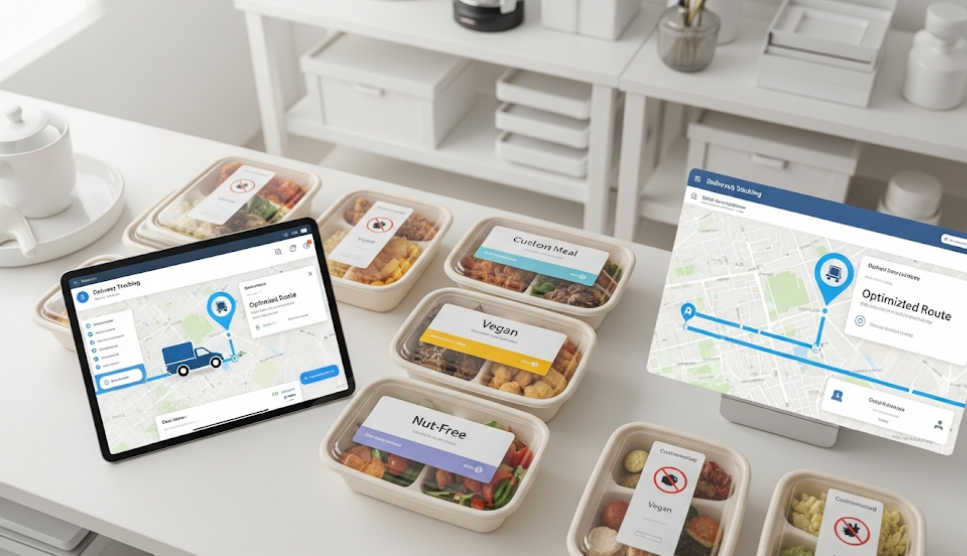
Delivery Planning and Route Optimization
Meal prep delivery software creates optimized routes for drivers, saving time and fuel while ensuring meals arrive fresh and on schedule.
Customer Management and Retention
Customer profiles store preferences, dietary restrictions, and order history. This allows businesses to offer personalized experiences and improve long-term retention.
What Catering Software Does
While meal prep software focuses on daily production, catering software is built for event-based and large-order operations. Catering involves additional complexity, such as varying guest counts, custom menus, staff coordination, and event logistics.

Key capabilities of catering software include:
Event and Order Scheduling
Catering software organizes multiple events, delivery times, and preparation schedules in one calendar, reducing conflicts and missed deadlines.
Menu Customization and Pricing
Businesses can build event-specific menus, apply dietary filters, and automatically calculate pricing based on ingredients and quantities.
Staff and Resource Management
Catering software helps assign chefs, servers, and drivers to specific events, ensuring the right resources are available at the right time.
Invoicing and Payments
Automated invoicing, deposits, and payment tracking improve cash flow and reduce administrative work.
Client Relationship Management
Catering businesses often rely on repeat corporate or event clients. Catering software stores client history, preferences, and feedback to support long-term relationships.
Performance and Profitability Tracking
Reports provide insight into event costs, margins, and operational efficiency, helping businesses make better pricing and planning decisions.
How Meal Prep Software and Catering Software Work Together
In modern food businesses, the line between meal prep and catering is increasingly blurred. Many meal prep companies expand into catering, while catering businesses launch meal subscription services. Using separate systems for each operation creates data silos and inefficiencies.
When meal prep software and catering software are integrated:
Inventory is shared across daily meals and events
Kitchens can plan production more accurately
Delivery routes are optimized across all order types
Staff scheduling becomes more efficient
Business owners gain a complete view of performance
This unified approach allows food businesses to scale multiple revenue streams without multiplying operational complexity.
Daily Business Benefits of Using Food Software
The impact of meal prep and catering software is felt every day, not just during growth phases. Businesses experience immediate operational improvements such as:
Faster order processing and fewer manual errors
More predictable kitchen workflows
Reduced food waste and better cost control
Improved delivery reliability
Better communication with customers
Increased customer satisfaction and repeat orders
Instead of reacting to problems, teams can focus on delivering quality food and improving the customer experience.
Supporting Health-Focused and Lifestyle-Driven Customers
A major driver behind the growth of meal prep businesses is the demand for healthier eating. Customers want meals that align with fitness goals, dietary preferences, and lifestyle choices.
Meal prep software supports this by enabling:
Consistent portion control
Accurate nutritional data
Custom meal plans for different diets
Transparency around ingredients and allergens
This combination of technology and nutrition builds trust and positions businesses as reliable partners in customers’ health journeys.
Key Features to Look for in 2026-Ready Food Software
As the industry evolves, not all software solutions are built for the future. In 2026, the most effective meal prep and catering software will include:
Automation across orders, production, and delivery
AI-driven demand forecasting and analytics
Cloud-based access for remote management
Scalable architecture for growing businesses
Integrated CRM and marketing tools
Reporting that supports smarter business decisions
Choosing software with these capabilities ensures long-term sustainability rather than short-term fixes.
How Sprwt Helps Meal Prep and Catering Businesses
Modern platforms like Sprwt demonstrate how meal prep software and catering software can work together in a single, unified system. Sprwt supports food businesses by combining automation, analytics, and operational tools designed for both daily meal prep and catering workflows.
Sprwt helps businesses by offering:
Automated cooking and batch production reports
Inventory tracking and waste forecasting
Delivery route optimization
Customer and subscription management
CRM, loyalty programs, and marketing tools
White-label customer experiences for branding
Cloud-based access for scalable operations
By centralizing these functions, Sprwt enables food businesses to operate efficiently while preparing for future growth.
The Future of Meal Prep and Catering Software
Looking ahead, food software is moving beyond basic management tools. The future lies in predictive systems that help businesses anticipate demand, reduce waste, and personalize customer experiences at scale.
Emerging trends include:
AI-powered forecasting for orders and inventory
Sustainability tracking and waste reduction metrics
Deeper integration between kitchen, delivery, and finance
More self-service options for customers
Data-driven insights that guide menu and pricing decisions
Food businesses that adopt these technologies early will be better positioned to lead the market.
Final Thoughts
Meal prep software and catering software are no longer optional tools-they are the foundation of modern food businesses. From daily kitchen operations to large-scale events, these systems bring structure, efficiency, and insight to complex workflows.
As customer expectations rise and competition increases, businesses that rely on automation and data will outperform those that don’t. Platforms like Sprwt show how integrated meal prep and catering software can simplify operations, support healthy food initiatives, and enable sustainable growth in 2026 and beyond.

Comments
Post a Comment