Meal Kit Software & Meal Delivery Software: How Modern Food Businesses Scale Efficiently
The food delivery and meal prep industry has evolved rapidly over the last few years. Customers now expect fast delivery, accurate orders, personalized meal plans, subscription flexibility, and real-time updates. For restaurants, meal prep companies, ghost kitchens, and catering businesses, meeting these expectations manually is becoming nearly impossible.
Many growing food businesses still rely on spreadsheets, phone calls, paper tickets, and disconnected tools to manage orders, deliveries, staffing, and kitchen operations. While this may work in the early stages, operational issues begin to appear as order volume increases.

Missed deliveries, incorrect orders, delayed preparation times, scheduling conflicts, and payroll headaches can quickly impact profitability and customer satisfaction.
This is where meal kit software and meal delivery software become essential. Modern platforms help food businesses centralize operations, automate repetitive tasks, and improve efficiency across the entire workflow — from ordering and kitchen management to staffing and delivery logistics.
What Is Meal Kit Software?
Meal kit software is designed to help meal prep companies, subscription meal businesses, and restaurants manage the operational side of preparing and selling ready-to-eat meals or meal kits.
Instead of handling everything manually, businesses can use software to automate and organize critical tasks such as:
Online ordering
Subscription management
Menu customization
Customer profiles
Meal selection
Payment processing
Production planning
Delivery coordination
For businesses offering weekly meal plans or recurring subscriptions, managing customer preferences manually becomes extremely time-consuming. Customers may request dietary modifications, portion changes, allergy adjustments, or delivery schedule updates. Without centralized software, tracking these details accurately can become difficult.
Meal kit software helps businesses streamline these processes while reducing administrative work and minimizing order errors.
For example, if a customer changes their meal preferences before the weekly cutoff time, the system can automatically update kitchen production counts and delivery planning without requiring multiple manual adjustments.
This level of automation helps businesses save time while improving operational accuracy.
What Is Meal Delivery Software?
Meal delivery software focuses on managing the logistics side of food delivery operations.
As delivery volumes increase, businesses often struggle with route inefficiencies, delayed orders, driver coordination issues, and communication gaps between dispatch teams and customers.
Meal delivery software helps solve these problems by providing tools for:
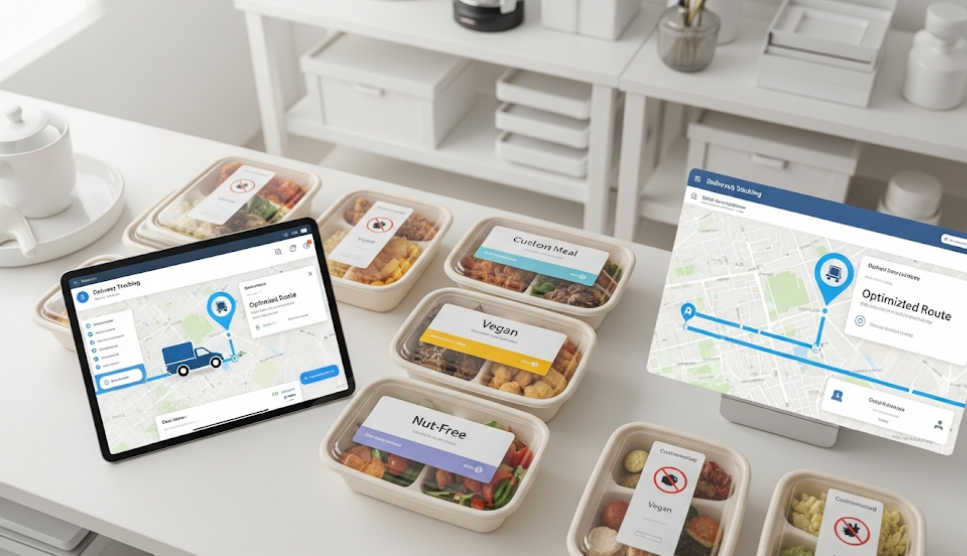
Delivery route optimization
Driver management
Dispatch coordination
Real-time order tracking
Customer delivery notifications
Delivery zone management
Multi-stop route planning
Delivery performance monitoring
Without delivery management systems, businesses may spend unnecessary money on fuel, driver overtime, and inefficient routes.
For example, manually assigning delivery routes can result in drivers crossing paths, longer delivery windows, and wasted operational time. Software-based route optimization automatically calculates more efficient delivery sequences based on distance, traffic patterns, and delivery schedules.
This not only improves operational efficiency but also creates a better customer experience through faster and more reliable deliveries.
Challenges Food Businesses Face Without Proper Software
Many food businesses experience operational bottlenecks long before they realize software is necessary.
At first, small inefficiencies may seem manageable. However, as order volume grows, these issues often become major obstacles to scaling.
Order Management Errors
Manual order entry increases the likelihood of:
Incorrect meal selections
Missing customer modifications
Duplicate orders
Lost tickets
Incorrect delivery addresses
Even small order mistakes can negatively affect customer trust and retention.
Kitchen Bottlenecks
Kitchens operating with paper tickets or disconnected systems often face:
Confusing preparation queues
Communication breakdowns
Delayed meal preparation
Missed modifications
Inefficient production workflows
As volume increases, these inefficiencies become more expensive.
Delivery Delays
Without proper delivery management tools, businesses commonly experience:
Poor route planning
Late deliveries
Driver confusion
Missed delivery windows
High fuel costs
Customers expect accurate delivery timing, especially for subscription-based meal services.
Staffing & Payroll Challenges
Restaurants and meal prep businesses often struggle with:
Employee scheduling conflicts
Overtime tracking
Manual payroll calculations
Inaccurate timesheets
Labor cost visibility
Managing staff manually becomes increasingly difficult across multiple shifts or locations.
Disconnected Systems
One of the biggest operational problems is using multiple disconnected tools for:
Orders
Payroll
Scheduling
Delivery management
Kitchen operations
Reporting
This creates duplicate work, inconsistent data, and unnecessary complexity.
Key Features Businesses Should Look for in Meal Kit Software & Meal Delivery Software
Not all food business software platforms are built the same. Businesses should prioritize systems that support operational efficiency, scalability, and centralized management.
Meal Prep Software
Meal prep businesses need systems capable of handling recurring subscriptions and large production volumes efficiently.
Modern meal prep software helps with:
Subscription meal plans
Recurring customer orders
Nutrition-based customization
Portion selection
Production forecasting
Bulk order management
Automated order organization
Instead of manually calculating ingredient requirements each week, businesses can use software to forecast production needs based on customer orders.
This improves kitchen planning while helping reduce food waste.
Catering Software
Catering operations involve more complexity than standard restaurant delivery.
Businesses often manage:
Large group orders
Event-specific requirements
Delivery coordination
Customer communication
Custom invoicing
Catering software helps businesses organize these workflows in one centralized system.
Features often include:
Event scheduling
Proposal generation
Invoice management
Delivery coordination
Customer order tracking
This improves organization while reducing manual administrative work.
HR Management: Timesheets, Scheduling, and Payroll
Labor management is one of the largest operational expenses for food businesses.
Without proper systems, managers often spend excessive time handling:
Shift scheduling
Employee availability
Timesheet tracking
Payroll calculations
Overtime monitoring
Integrated HR management tools help automate these processes.
Businesses can:
Create staff schedules more efficiently
Track employee hours accurately
Reduce payroll errors
Monitor labor costs
Improve workforce visibility
This becomes especially valuable for businesses operating across multiple kitchen locations or delivery teams.
Point-of-Sale (POS)
A centralized POS system helps unify online and in-store ordering operations.
Important POS capabilities include:
Payment processing
Order synchronization
Customer purchase tracking
Sales reporting
Menu management
Multi-channel order integration
Instead of managing separate systems for online orders and in-store transactions, businesses can centralize data into one operational workflow.
This improves reporting accuracy and simplifies day-to-day management.
Kitchen Information Display System (KIDS)
Kitchen communication becomes increasingly important as order volume grows.
Traditional paper ticket systems can create:
Lost orders
Miscommunication
Delayed preparation
Inconsistent workflows
A Kitchen Information Display System (KIDS) digitizes kitchen operations by displaying orders in real time.
Benefits include:
Faster kitchen communication
Improved order visibility
Reduced ticket confusion
Better preparation timing
Increased order accuracy
This helps kitchens operate more efficiently during peak hours.
Delivery Route Optimization
Delivery logistics directly affect profitability.
Poor routing leads to:
Increased fuel costs
Longer delivery times
Driver inefficiencies
Reduced customer satisfaction
Delivery route optimization software helps businesses plan more efficient delivery routes automatically.
This improves:
Delivery speed
Driver productivity
Fuel efficiency
Delivery accuracy
Overall customer experience
For businesses handling dozens or hundreds of deliveries daily, route optimization can significantly reduce operational costs.
How Integrated Systems Help Businesses Scale Faster
As food businesses grow, disconnected tools often create operational friction.
An integrated system allows businesses to connect:
Orders
Kitchen operations
Delivery management
Staff scheduling
Payroll
Customer management
Reporting
Instead of manually transferring information between systems, businesses can automate workflows across departments.
This creates several advantages:
Reduced Human Error
Automation minimizes manual data entry mistakes and improves operational consistency.
Faster Operations
Integrated workflows reduce delays between ordering, preparation, dispatch, and delivery.
Better Customer Experience
Accurate orders and faster deliveries improve customer retention and repeat business.
Improved Reporting
Businesses gain better visibility into:
Sales trends
Labor costs
Delivery performance
Operational bottlenecks
Easier Scalability
Businesses can expand operations more efficiently without dramatically increasing administrative overhead.
Signs Your Food Business Has Outgrown Manual Processes
Many businesses continue using manual systems longer than they should.
Some common warning signs include:
Orders being missed frequently
Customer complaints increasing
Delivery operations becoming difficult to manage
Staff scheduling confusion
Managers spending excessive time on admin work
Difficulty tracking labor costs
Inconsistent kitchen workflows
Growing operational inefficiencies
If these issues are becoming regular occurrences, implementing centralized software may be necessary for continued growth.
Future Trends in Meal Delivery & Meal Kit Technology
Technology continues to reshape the food delivery industry.
Several trends are expected to influence how businesses operate in the coming years.
AI-Driven Forecasting
Businesses are increasingly using predictive analytics to forecast:
Customer demand
Ingredient requirements
Staffing needs
Delivery volume
This helps improve planning and reduce waste.
Automated Dispatching
Modern systems are improving delivery coordination through automated driver assignment and smart routing.
Subscription-Based Growth
Recurring subscription meal plans continue to grow in popularity because they provide predictable revenue and stronger customer retention.
Real-Time Analytics
Businesses increasingly rely on live operational dashboards to monitor:
Delivery performance
Kitchen efficiency
Sales trends
Labor usage
Connected Operational Ecosystems
Rather than using multiple disconnected tools, businesses are moving toward fully integrated operational systems that centralize all workflows in one platform.
Conclusion
Running a successful meal prep, catering, or food delivery business requires much more than simply preparing quality food. As operations grow, businesses need systems that improve efficiency, reduce operational friction, and support long-term scalability.
Meal kit software and meal delivery software help businesses manage ordering, kitchen workflows, staffing, payroll, customer communication, and delivery logistics more effectively.
Integrated platforms can significantly reduce manual work while improving operational visibility and customer experience.
Solutions like Sprwt help food businesses unify meal prep operations, catering management, HR tools, POS systems, kitchen display workflows, and delivery route optimization into one connected ecosystem designed to support growth and operational efficiency.


Comments
Post a Comment